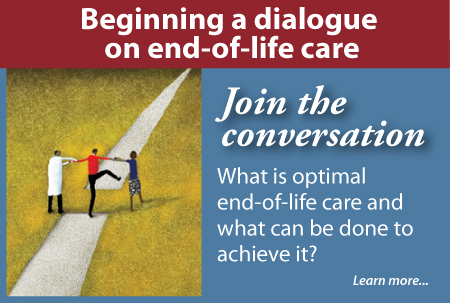
We want to hear your voice in our conversation about end-of-life care
What can be done to help achieve optimal end of life care?
The experts describe a current environment where assumptions and misunderstandings – between physician and patient, among specialists and within families – can replace informed discussion.
Given that lack of communication appears to be a major barrier to optimal end-of-life care, we’ve decided to launch a conversation.
We hope you will share your views.
Current Conversations
Each “conversation” will bring you the views of experts in palliative and end-of-life care, as well as lessons learned from patients’ experiences.

Topic 5: Medical Futility at End of Life NEW
Negotiating care when either the physician, the patient, or the Substitute Decision-Maker believes that care is futile is a delicate process built upon respect of the patient and professional values. What can be done when there are discrepant values or goals of care between the team, patient, and/or family?
READ MORE
Click here to join the conversation

Topic 4: Certifying Death at Home
Family physicians have an important role to play when it comes to certifying their patient’s death at home.
READ MORE
Click here to join the conversation

Topic 3: Interprofessional Collaboration in Palliative Care
Collaboration between various disciplines is desirable in every area of health care. In palliative care, it’s the nature of patient and family needs that makes teamwork absolutely essential.
READ MORE
Click here to join the conversation

Topic 2: Advance Care Planning
Advance Care Planning is more than having a “Do Not Resuscitate” order in your medical file, or a narrow checklist of what care you do or don’t want. It’s a process over time of considering future health care and identifying your preferences.
READ MORE

Click here to join the conversation

Topic 1 : Education, Training and Continuing Professional Development
Are physicians receiving the palliative care education necessary to provide quality end-of-life care?
What novel tools are being used to educate physicians on the complex nuances of palliative medicine?
READ MORE
Click here to join the conversation